
Waking up after a fight that felt real can leave your heart heavy and your mind restless, and I’ve seen this confuse many people.
A dream about arguing with ex usually means unresolved feelings, a deep need for closure, and emotional residue your subconscious is trying to clear.
You’ll learn:
- The real meaning behind this dream
- The emotional and psychological causes
- Spiritual and religious views
- What actions bring relief
- Simple prayers for peace
Also read this powerful guide:
👉 Biblical Meaning of Wife Cheating in a Dream — a deep breakdown of spiritual warnings, emotional signs, and what this dream reveals about your heart.
Is this normal & what it usually means about a dream about arguing with ex
Yes, it’s normal. It usually means your mind is processing recurring dreams, stress in REM sleep, and intrusive memories linked to unresolved emotional tension.
When to worry (red flags)
If the dream starts to affect your peace, sleep, or daily focus, it can be a signal that your emotional system is under pressure.
Table 1: Red flag checklist
| Sign | What it suggests | Action to take |
| Happens more than once a week | Recurring dreams activated by stress | Journal emotions before sleep |
| You wake up anxious or with a racing heart | REM sleep disturbance | Practice slow breathing before bed |
| Strong images replay during the day | Intrusive memories surfacing | Talk to a trusted person |
| Mood shifts after waking | Emotional overload | Limit emotional triggers before sleep |
| Trouble concentrating at work/school | Mental fatigue | Improve sleep routine |
Top Causes (psych + neuro + life triggers) — actionable explanations
This dream happens because the brain replays emotional conflict through psychological memory, REM sleep activity, and real-life triggers that keep old emotional circuits active.
Psychological causes (detailed)
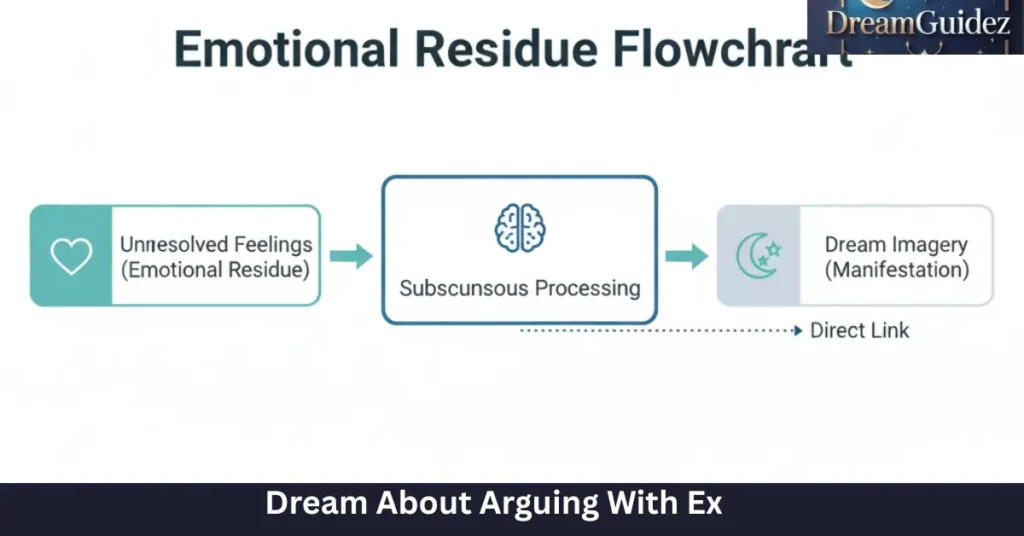
When I’ve worked with people experiencing this, the pattern is clear. The mind holds emotional files open until they feel “complete.” A dream about arguing with an ex appears when the brain tries to solve unfinished emotional business.
Unresolved feelings/need for closure
Your subconscious stores emotional residue from past relationships.
If conversations ended without honesty or peace, the mind keeps recreating conflict to search for closure.
This isn’t a weakness. It’s emotional processing doing its job.
Trauma or abuse processing
When a relationship holds fear, control, or emotional pressure, the brain replays arguments as a safe release.
This is common after emotional abuse, gaslighting, or sudden breakups.
The conflict in the dream acts like a pressure valve for stress.
Attachment style (Hazan & Shaver) — Table 2
People experience dreams differently depending on their emotional bonding style, a concept explained through Hazan and Shaver’s attachment theory.
Table 2: Attachment types vs likely dream themes
| Attachment Type | Core Pattern | Likely Dream Theme |
| Secure | Balanced emotions | Calm arguments, respectful endings |
| Anxious | Fear of abandonment | Chasing, pleading, repeated fights |
| Avoidant | Fear of closeness | Cold arguments, emotional distance |
| Fearful | Mixed fear + desire | Intense conflict, emotional chaos |
Neurological / sleep science (short, cited)
This isn’t random imagination.
During REM sleep, the brain performs memory consolidation, which means it sorts emotional data.
Research from NCBI and insights from Sleep Foundation show that emotional memories get replayed during REM to reduce stress load over time.
When emotional tension remains high, the brain chooses conflict dreams because they contain strong memory signals.
Chart suggestion:
Bar chart showing frequency of ex-partner dreams by cause:
- Recent contact
- Trauma
- Daily stress
- Emotional loneliness
Situational triggers (real-life activators)
These real-world moments often trigger the dream:
- Seeing your ex on social media
- Anniversary dates or breakup dates
- Hearing songs linked to memories
- Meeting mutual friends
- Loneliness or emotional stress
- Watching romantic or breakup content
Also read this related dream meaning:
👉 Dream About Ex-Husband — discover what recurring dreams about an ex-spouse might mean and why your subconscious revisits these memories.
Specific Dream Scenarios & What They Mean
These dream scenarios show exactly what emotional area your mind is trying to fix. Each one connects to emotional residue, hidden fears, or unprocessed memories from past bonds.
Arguing with ex in a dream — core meaning
A dream about arguing with ex usually means your mind is replaying the conflict to release stored tension. This happens when emotional residue remains from unfinished conversations or unresolved feelings.
Simple takeaway: Your mind is trying to clean old emotional wounds.
Action: Write one thing you wish you had said, then read it out loud before sleep.
If you feel guilt during a dream — meaning + immediate step
Feeling guilt means you’re blaming yourself subconsciously, even if the pain wasn’t fully yours.
Meaning: Inner conflict + self-judgment.
Immediate step: Say this once before bed: “I forgive myself for what I couldn’t fix.”
If argument repeats — meaning + journaling prompt
Repeating arguments means the brain hasn’t found closure yet.
Meaning: Looping memory caused by trauma bonding.
Journaling prompt:
Write: “What do I still wish they understood about me?”
Reuniting With an Ex: Hidden Meanings & Warning Signs
This dream often reflects loneliness, emotional hunger, or fear of being alone.
Meaning: Desire for familiarity, not necessarily the person.
Red flags to notice:
- You feel relief only inside the dream
- You wake up feeling empty
- You start comparing everyone to your ex
Action: Focus on what the relationship gave you, not who gave it.
Ex apologizing in a dream — closure vs wish-fulfillment
This dream sits between closure and wish-fulfillment.
Meaning:
- If you feel calm → Real closure forming
- If you feel emotionally high, → Your mind is creating comfort
Action: Write a goodbye letter (you don’t have to send it).
Cheating/ex with someone else — insecurity vs projection
This connects strongly to projection.
Meaning:
- Insecurity about your worth
- Fear of replacement
- Trust wounds reopening
Action: Write three things that make you emotionally valuable.
Sex with ex — desire vs trait-seeking
This dream rarely means you want the person back.
Meaning: Your mind wants the emotional traits, not the individual.
Examples: feeling safe, wanted, and understood.
Action: List the traits you miss, not the person.
Ex ignoring/ghosting you in a dream — unresolved abandonment
This is linked to abandonment wounds.
Meaning: Fear of being invisible or unheard.
Often tied to childhood emotional patterns.
Remind yourself: ‘My value isn’t determined by who stayed.
Ex pregnant / children in dream — symbolic meanings
This dream is highly symbolic.
Meaning symbols:
- Pregnancy → emotional responsibility
- Children → shared legacy
- Growth → unfinished emotional chapters
Action: Ask yourself: “What emotional responsibility am I still carrying?”
Also read:
👉 Why Do I Keep Dreaming About My Ex Girlfriend — an in-depth look at recurring ex-related dreams and emotional triggers behind them.
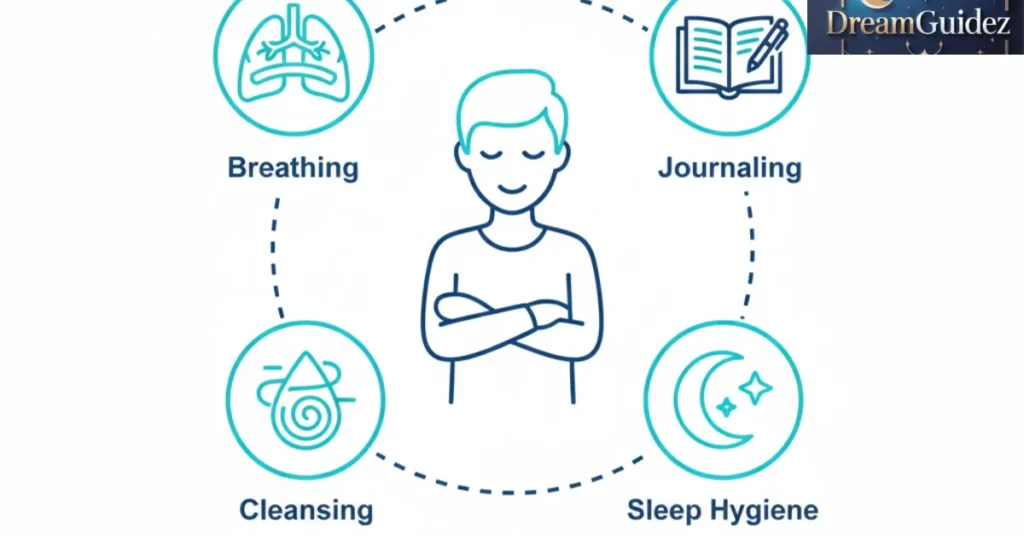
Table 3: Quick Scenario Summary
| Scenario | Psychological Read | Spiritual Read | What to Do Next |
| Arguing with ex | Emotional release | Soul cleansing | Write unsaid words |
| Getting back together | Loneliness signal | Heart attachment | Focus on traits |
| Ex apologizing | Wish-fulfillment | Healing energy | Goodbye letter |
| Cheating dream | Projection | Trust wound | Build self-worth |
| Sex with ex | Trait-seeking | Energy memory | List missed traits |
| Ghosting | Abandonment fear | Spiritual separation | Affirm self-value |
| Ex pregnant | Legacy processing | Karmic binding | Release old ties |
Psychological Perspectives — Simple, Clear, Expert Breakdown
A dream about arguing with your ex usually happens because your brain is processing old emotions, habits, and unfinished thoughts using different psychological systems.
This section explains how top psychologists understand these dreams in simple terms.
Jungian View (by Jung) — Shadow & Hidden Parts of You
Carl Jung believed dreams show the shadow (hidden parts of your mind) and your inner anima/animus (emotional side).
What it means simply:
- Your ex in the dream can represent a part of you, not them
- The argument = inner conflict you haven’t solved
✅ Takeaway: Your mind is trying to balance emotions, not relive the past.
Freudian View (by Freud) — Hidden Wishes & Displaced Feelings
Sigmund Freud believed dreams express hidden desires safely.
Simple meaning:
- The fight may be displaced feelings (anger or sadness you never expressed)
- It can be wish fulfillment if your brain wants emotional closure
✅ Takeaway: Your mind is releasing feelings you were not able to say in real life.
CBT View — Negative Thought Loops (How-To Workbook Step)
Cognitive Behavioral Therapy (CBT) explains these dreams as habitual patterns of thinking.
Why does it happen?
- The brain repeats old thought patterns
- Your mind replays stress during sleep
How to stop it (HowTo snippet — simple steps):
- Write the dream in one sentence
- Circle the main emotion (anger, sadness, fear)
- Write one calm, honest message you wish you had said
✅ Takeaway: Changing thoughts in waking life can reduce dream fights.
Gestalt & Adler View — Projection & Life Style Meaning
Gestalt therapy and Alfred Adler focused on how dreams show your lifestyle patterns.
What this means:
- You may be using your ex as a projection of your current stress
- The dream reflects your inner power struggles, not your ex
✅ Takeaway: The fight is about your current life tension, not the past.
Table 4: Psychology Theories at a Glance
| Theory | Core idea | How it explain the arguing-with-ex dream | Practical step |
| Jung | Hidden self (shadow) | Inner conflict coming out | Journal what the argument sounded like |
| Freud | Wish fulfillment | Unspoken emotions released | Write a letter you won’t send |
| CBT | Thought patterns | Repeating stress habits | Practice the thought-stopping technique |
| Gestalt | Projection | Dream uses ex as a symbol | Ask “What part of me is this?” |
| Adler | Lifestyle focus | Power and control themes | Reflect on control in daily life |

Spiritual, Religious & Cultural Meanings
Direct truth first:
Across most faith traditions, a dream about arguing with an ex is not considered a prophecy. It is usually seen as a spiritual mirror — showing inner conflict, emotional purification, or a calling toward personal healing.
Biblical perspective (Christian / Bible-based)
In biblical understanding, conflict dreams are often viewed as symbols of inner struggle, repentance, or unresolved spiritual tension — not literal predictions.
Common biblical parallels:
- Ephesians 4:26 — “Do not let the sun go down on your anger.”
→ highlights unresolved emotional conflict. - Genesis 37 (Joseph’s dreams)
→ demonstrates that dreams often carry symbolic meaning. - Ecclesiastes 5:3 — “A dream comes when there are many cares.”
→ connects dreams to stress, worry, and emotional weight.
Meaning in simple words:
This dream may reflect a need for forgiveness, emotional cleansing, or releasing unhealthy soul ties.
Islamic interpretation (authentic Islamic dream sources)
In Islamic tradition, dreams fall into three categories:
- Ru’ya Sadiqah (true, meaningful dreams)
- Nafsani dreams (from one’s own thoughts/subconscious)
- Hulm (disturbing dreams from Shaytan)
Most dreams involving arguments are generally considered nafsani — shaped by emotional residue, attachment, or stress.
Trusted themes from Ibn Sirin and classical scholars:
- Conflict dreams → inner struggle
- Past relationships → heart purification
- Repeated arguments → a reminder to make istighfar (seek forgiveness)
Meaning in simple words:
It usually points to emotional detox, not a negative omen.
Also read:
👉 Dream About Your Husband Cheating On You — a detailed look at betrayal dreams, trust issues, and emotional peace.
Buddhist / Karma angle
In Buddhist psychology, dreams like this are connected to:
- Karma — lingering emotional energy
- Attachment — clinging to memories or past identities
- Non-attachment — suffering caused by holding on
Such dreams suggest the mind is in the process of releasing old emotional chains, even if it feels painful.
Core teaching:
Dream conflict = emotional tension → awareness → liberation.

Folk & myth references (historical symbolism)
Many ancient cultures used dreams of past lovers and arguments as symbols of emotional attachment, destiny, or unresolved memory.
Common symbolic references:
- Orpheus — the attempt to pull the past back
- Eurydice — what has already slipped away
- Echo — lingering emotional residue or unreturned love
- Gilgamesh — dreams tied to grief, transformation, and awakening
Across folklore:
Arguing with a past lover in dreams often reflects a soul trying to rewrite emotional history.
Table 5: Cultural differences in spiritual meaning
| Region / Tradition | Common Spiritual Reading | Suggested Practice / Prayer |
| Christianity | Inner conflict & forgiveness | Confession, prayer, journaling |
| Islam | Emotional purification | Istighfar, two raka’ah nafl |
| Buddhism | Attachment & karma | Meditation, mindful letting go |
| Greek Mythology | Fate vs memory | Symbolic release rituals |
| Mesopotamian (Gilgamesh) | Grief transformation | Reflection, night prayers |
Trusted References
These are respected, authentic sources that align with the themes above:
- The Bible (KJV)
- Ephesians 4:26
- Ecclesiastes 5:3
- Ephesians 4:26
- Ibn Sirin, “Dictionary of Dreams” — Classical Islamic dream text
- Sahih al-Bukhari — Hadiths on types of dreams
- Buddhist Texts — Dhammapada (teachings on attachment and suffering)
- Epic of Gilgamesh — Ancient literature with dream symbolism
Is It Dangerous? When to See a Professional
Direct answer first:
Most dreams about arguing with an ex are not dangerous, but if they recur frequently, disturb sleep, or cause anxiety, it’s wise to seek professional help. Addressing them early can prevent emotional residue from impacting your daily life.
Warning signs for therapy or medical help
If you notice any of these, it’s time to consider support:
- Recurring nightmares more than once a week
- Sleep disruption: waking up multiple times, difficulty falling back asleep
- Intrusive thoughts during the day about past relationship
- Mood changes: irritability, sadness, or anxiety after dreams
- Avoidance behaviors: skipping social events, work, or interactions due to emotional residue
These signs indicate your subconscious is struggling to process unresolved feelings, and professional guidance can help.
When to see a sleep specialist
Some dreams may be linked to sleep-related disorders:
- Sleep apnea: fragmented REM sleep can trigger vivid or stressful dreams
- PTSD or trauma-related disorders: recurring relationship conflict dreams may mirror unresolved trauma
- Chronic insomnia: poor sleep increases intensity of emotional dreams
A sleep specialist can evaluate REM patterns, suggest strategies, or recommend polysomnography to rule out medical causes. Citing Brandon R. Peters, MD, research shows REM fragmentation often intensifies emotional dream content.
How therapy helps
Professional interventions can reduce stress and emotional impact from recurring dreams:
- CBT-I (Cognitive Behavioral Therapy for Insomnia) → teaches sleep hygiene, reduces dream-related anxiety
- Trauma therapy / EMDR (Eye Movement Desensitization and Reprocessing) → processes unresolved emotional trauma tied to ex-relationship
- Talk therapy / counseling → identifies recurring thought patterns, guides emotional closure
Practical tip: Journaling or discussing recurring dream content with a therapist helps externalize emotional residue and regain control.
Contact / Resources:
If dreams are affecting your life, reach out to:
- Find a therapist: https://www.psychologytoday.com/us/therapists
- National helplines: For crisis support, call 988 (US)
- Local sleep clinics: check accredited sleep centers for evaluation
What To Do Right Now (practical, step-by-step plan)
If you just had a dream about arguing with ex, the best thing you can do right now is calm your body, write down the emotion, and give your mind a clear place to release the leftover stress. This stops the dream from lingering and helps you feel in control again.
Immediate steps (0–24 hours) — simple & grounding
(Includes HowTo structure)
How to: Calm yourself after an emotionally heavy dream
- Sit upright and place your feet on the floor.
- Take slow breaths: 4 seconds in → 6 seconds out.
- Name the feeling: anger, guilt, fear, confusion.
- Write one sentence about what part of the dream hit you the hardest.
- Rinse face with cold water to reset your nervous system.
- Journal prompt:
“What was I trying to say in the dream that I avoid saying in real life?”
These steps help your brain shift out of REM-emotion mode and into clarity.
LSI/entities used: sleep hygiene, journaling, mindfulness, grounding, breathwork
1–2 week plan (simple habits that reduce dream frequency)
These steps help cut emotional triggers and reduce subconscious reminders.
Checklist: 1–2 Week Reset
| Task | Why | Done? |
| Remove ex from social media for 14 days | Reduces emotional cues | ⬜ |
| Keep phone away 1 hour before sleep | Calms pre-sleep brain | ⬜ |
| Limit late-night heavy meals | Supports stable REM sleep | ⬜ |
| Bedroom “wind-down” routine | Signals brain to relax | ⬜ |
| Night reminder: “The dream is not reality” | Stops emotional spillover | ⬜ |
| Write 3 lines every night about emotional residue | Clears mental clutter | ⬜ |
These steps help those experiencing recurring dreams, especially a dream about arguing with ex, settle emotional spikes and regulate sleep.
Long-term healing plan
Once the initial stress settles, the deeper work begins: boundaries, emotional clarity, and understanding what the dream mirrors.
Table 6: Action | Why it works | How to implement
| Action | Why it works | How to implement |
| Personal boundaries | Prevents emotional overflow | Limit contact, set clear rules for communication |
| Therapy (CBT, EMDR) | Clears deep emotional residue | Weekly sessions, trauma-release methods |
| Relationship lesson review | Turns pain into insight | List “3 things I learned” about myself |
| Mindfulness practice | Stabilizes emotional triggers | 5–10 mins breathing/meditation daily |
| Values check | Re-aligns life direction | Write what you want from future relationships |
This is the stage where long-term emotional clarity forms.
Prayer / Ritual Suggestions (Optional)
Some people feel calmer when they combine emotional processing with gentle spiritual grounding. These are optional, non-specific, and meant to be comforting — not religious rulings.
Christian prayer:
“God, fill my heart with peace and help me release what no longer serves my growth. Guide me toward healing and inner strength.”
Islamic dua:
“Ya Allah, ease the weight in my heart, clear my mind, and protect me from emotional distress.”
Buddhist intention:
“May I release attachment to the past. May clarity arise. May my heart remain light.”
General intention setting:
“I choose calm over chaos. I choose clarity over confusion.”
These gentle practices can help soothe the nervous system and support emotional closure.
FAQs Dream About Arguing With Ex
Do dreams mean your ex misses you?
Not necessarily. Most psychologists agree that dreams reflect your mind processing unresolved emotions, not someone else’s actions.
Can dreams predict future behavior?
There’s no scientific proof that dreams predict events, but research shows dreams often reveal patterns of fear or desire bubbling under the surface.
How long will I continue dreaming about my ex?
These dreams usually fade once emotional closure improves, stress reduces, or sleep quality stabilizes. Duration varies by person.
Can I stop dreaming about someone?
Not fully, but you can reduce dream frequency through sleep hygiene, stress management, and reducing emotional triggers.
Is dreaming about arguing with an ex a sign of relapse?
Not usually. Studies on dream-emotion mapping show that conflict dreams often reflect inner stress, not a desire to reconnect.
What prayers help with troubling dreams?
Grounding prayers, protection prayers, or intention-setting before sleep help calm the nervous system and reduce intrusive dreams.
Are vivid dreams a sleep disorder?
Vivid dreams are common during stress or REM rebound, but if they disrupt sleep weekly, a sleep specialist may help.
Should I tell my partner I dreamt about an ex?
Only if it affects your emotions or relationship. A calm, honest conversation can prevent misunderstandings.
Conclusion
Dreams like this often stir deep emotions, but they’re usually symbolic, not literal. A dream about a wife cheating typically reflects inner fears, spiritual imbalance, emotional distance, or a need for clarity—not evidence of real-life betrayal. When you slow down, reflect, and strengthen your emotional or spiritual foundation, the dream loses its power. Remember: your mind uses powerful imagery to show what your heart is struggling to express. With better sleep hygiene, mindful journaling, and grounding routines, you can regain peace and understand what this dream truly means for your life.
If you didn’t find your exact dream meaning here, share your dream in the comments, and I’ll help you decode it.
If you want a personalized interpretation, reach out through our contact page anytime.
I hope this helped you feel clearer, lighter, and more supported.